Download Troy Sans Font Family From Indian Type Foundry

Download Troy Sans Font Family From Indian Type Foundry
Download Troy Sans Font Family From Indian Type Foundry Download Troy Sans Font Family From Indian Type Foundry Download Troy Sans Font Family From Indian Type Foundry


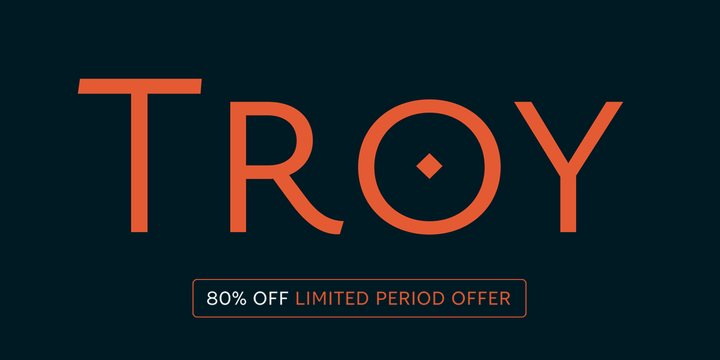
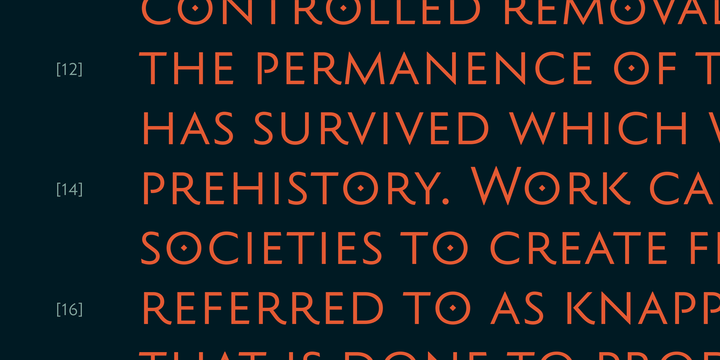
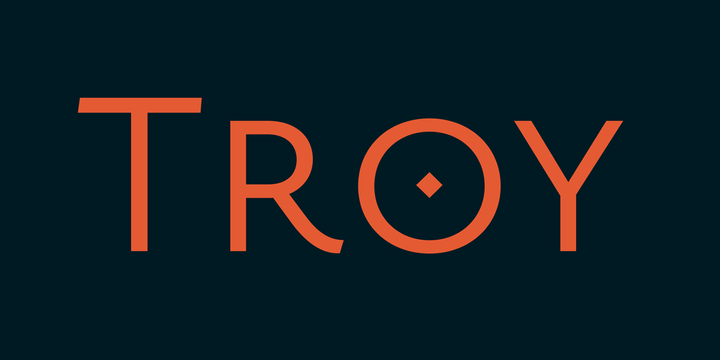
Troy is a pair of related sans and serif titling fonts. Each version is available in a single weight. The fonts’ lowercase letters all take the form of small capitals. Particularly the serif font – simply called Troy – is reminiscent of inscriptional letterforms. This tip of the hat to the very origins of our Roman capital letters gives the typeface an immediate feeling of formality and solemnity. Troy Sans, while sharing Troy’s proportions, feels more contemporary – although its letters would not be out of place on an inscription, either. Each of the fonts contain several alternate letterforms. In Troy, some of the alternate letters contain a mystical feeling; in Troy Sans, the same alternates look almost medieval, particularly ‘A’, ‘E’, ‘G’, ‘a’, ‘e’, and ‘g’. Other alternate characters are more sober versions of the default letterforms: in their default state, for instance, the ‘O’, ‘Q’, ‘o’, and ‘q’ each have a dot inside of their counters. The alternate versions of those letters are dotless. There are three versions of the ampersand in each font, too, as well as eighteen ligatures. Included among those are ligatures like ‘LI’ and ‘CO’, where the second letter is cradled inside of the counter of the first, as well as doubled letters like ‘NN’, ‘OO’, and ‘TT’ that were found in Ancient Roman inscriptions. The Troy fonts were designed by Ilya Naumoff, a graphic and typeface designer in Paris.


Download Troy Sans Font Family From Indian Type Foundry Download Now View Gallery


Popular posts from this blog

Download Elektrakution Font Family From Comicraft

Download Elektrakution Font Family From Comicraft SHE'S DEAD, FRANK It's the year 1991, BC (Before Comicraft) when REM were still making records and Frank Miller’s memorable run on Marvel Comics’ DAREDEVIL was just over ten years old. Comicraft’s Richard Starkings found himself working in Anaheim, California for Graphitti Designs. Graphitti had produced the first hardcover edition of Miller’s Batman tale, DARK KNIGHT RETURNS and was now putting together the sequel to Miller’s DAREDEVIL — ELEKTRA LIVES AGAIN! Richard was not engaged to letter this book, the pages of Frank’s incredible original art that came through Graphitti’s studio were already lettered by Marvel Stalwart, Jim Novak. However, there were some cover elements that needed to be added, based on the logo originally rendered by Frank’s brother, Steve. Starkings set about the task of creating an alphabet that could be used to develop Steve’s idea for the trade dress -- the c...

Download Awwam Font Family From Eyad Al-Samman

Download Awwam Font Family From Eyad Al-Samman Awwam refers to the region of Awwam which is now thought by most scholars to be Ma'rib or the famous temple of Awwam otherwise known as Mahram Bilqis. The Awwam temple - Arabic Haram Bilqis or Mahram Bilqis - is a Sabaean temple near Ma'rib in today's Yemen. It was built by Mukarrib "Yada'il Dharih I" between the 7th and 5th century B.C. Also, one of the most frequent titles of the God "Almaqah" was the Lord of Awwam. Almaqah was the main God of the ancient Yemeni kingdom of Saba' and also the kingdoms of Dímt and Aksum in Eritrea and Northern Ethiopia. Different members of the ruling dynasties of Saba' regarded themselves as Almaqah's children. Awwam is a wide and headline Arabic display typeface. The main trait of this typeface is the wide, curved, and streamlined design of its wide kashida, letters, and ligatures. This feature renders it as one...

Download Banknote 1948 Font Family From Ingo

Download Banknote 1948 Font Family From Ingo A very expanded sans serif font in capital letters inspired by the inscription on a bank note Old bank notes tend to have a very typical typography. Usually they carry decorative and elaborately designed markings. For one thing, they must be practically impossible to forge and for another, they should make a respectable and legitimate impression. And in the days of copper and steel engravings, that meant nothing less than creating ornate, shaded or otherwise complicated scripts. Designing the appropriate script was literally in the hands of the engraver. That’s why I noticed this bank note from 1948. It is the first 20 mark bill in the then newly created currency ”Deutsche Mark.“ All other bank notes of the 1948 series show daintier forms of typography with an obvious tendency toward modern face. The 1949 series which followed shortly thereafter reveals the more complicated script as well. For what...